
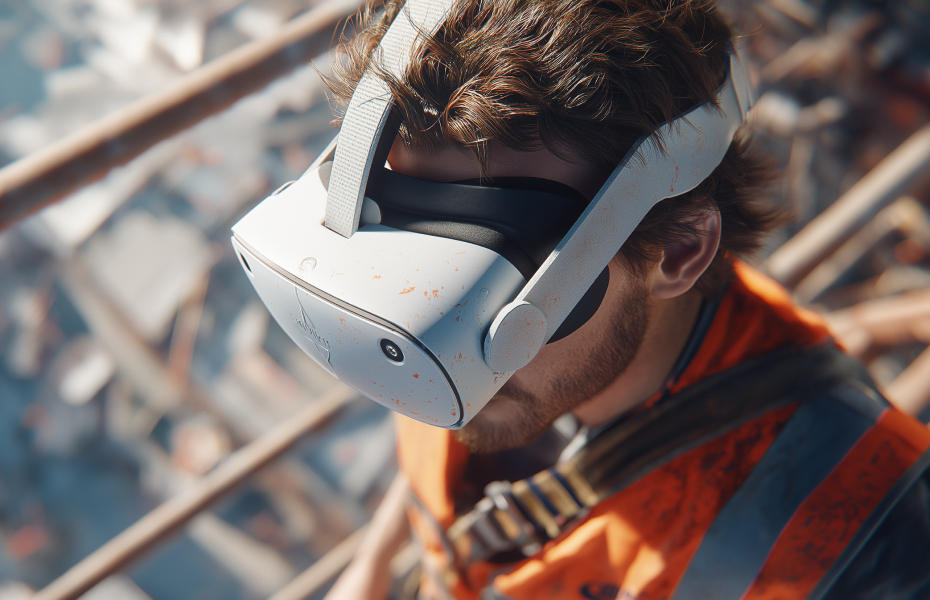
The benefits of VR training are reshaping how high-risk industries prepare workers for dangerous tasks. Construction, manufacturing, oil and gas, and mining all share a common challenge, workers must develop competency in hazardous activities where mistakes carry serious consequences.
Traditional training methods attempt to bridge the gap between classroom knowledge and job site performance, but they are limited by the fundamental tension between realism and safety.
Virtual reality resolves that tension by placing workers inside fully immersive simulations where they can practice high-risk procedures, make decisions under pressure, and learn from errors without any exposure to real danger.
Why Traditional Training Falls Short in High-Risk Work
High-risk industries have relied on a combination of classroom instruction, toolbox talks, video modules, and supervised on-the-job practice for decades. These approaches cover the necessary regulatory content, but they share a structural weakness, they cannot safely recreate the conditions that make high-risk work dangerous.
Classroom sessions deliver information about hazards, procedures, and compliance requirements. Workers listen, take notes, and pass written assessments. The problem is that passive learning produces low retention.
Research consistently shows that lecture-based methods result in retention rates as low as five to ten per cent, meaning workers forget the vast majority of what they were taught within days. This is a significant concern in industries where a forgotten procedural step can lead to a fatality.
On-the-job training offers more realism, but it introduces genuine risk. A new construction worker learning to operate equipment at height is exposed to the very hazards their training is supposed to protect them from.
Supervisors must balance instruction with productivity, and the dynamic nature of live job sites means training conditions are rarely consistent or controlled.
Video-based modules sit between these two extremes. They provide visual context that classroom instruction lacks, but they remain a passive medium. Workers watch rather than do, and there is no reliable way to verify whether they can actually perform the procedures they have seen demonstrated.
The result across all these methods is a workforce that is informed but not necessarily competent, certified but not always prepared for the situations they will encounter.
How VR Overcomes These Limitations
VR training works by immersing workers in three-dimensional digital environments that replicate their actual workplaces. Using a headset and controllers, they interact with the virtual space, operating equipment, identifying hazards, following procedures, and responding to scenarios that mirror real conditions.
The experience is active, repeatable, and measurable, and it addresses the specific weaknesses of traditional approaches.
The most immediate advantage is the elimination of physical risk during training. A construction worker can experience a fall-from-height scenario, a scaffolding failure, or an equipment malfunction in a virtual environment without any possibility of injury.
This allows training programs to expose workers to the exact situations that cause the most harm on real job sites, which are precisely the situations that traditional training either avoids or can only describe in the abstract.
Immersion drives engagement, and engagement drives retention. When workers are active participants in a scenario rather than passive observers, their brains process and store information more effectively.
Studies indicate that VR-based training can produce retention rates of seventy-five per cent or higher, compared to the single-digit retention typical of lecture formats. Workers remember what they practiced because they experienced it, not because they read about it.
Organizations looking to build a strong safety culture find that this experiential approach accelerates the shift from compliance-driven awareness to genuine behavioral change.
VR also delivers consistency that other methods cannot match. Every worker completes the same scenario under the same conditions, regardless of location, trainer availability, or weather.
This standardization is particularly valuable for organizations operating across multiple sites, where training quality can vary significantly depending on local resources and personnel.
Specific Benefits Across High-Risk Industries
While the core advantages of VR apply broadly, different industries gain specific benefits from immersive training.
In construction, workers face what regulators call the "Fatal Four", falls, struck-by incidents, electrocutions, and caught-in or caught-between hazards. These account for the majority of construction fatalities.
VR simulations allow workers to practise fall protection procedures on virtual scaffolding, identify electrical hazards in simulated trenches, and respond to struck-by scenarios involving moving equipment.
The hazard identification skills workers develop in these sessions transfer directly to real job sites because the visual and spatial cues in VR closely match what they will encounter on the ground.
In manufacturing, VR enables workers to rehearse lockout-tagout procedures, machine guarding protocols, and chemical handling sequences in virtual replicas of their production lines. Operators build procedural confidence through repetition without tying up production equipment or creating exposure risks for themselves or colleagues.
In oil and gas and mining, VR addresses the challenge of training for low-frequency, high-consequence events. Blowouts, gas releases, and underground collapses are rare, but when they occur, the response must be immediate and correct.
VR makes it possible to rehearse these emergency scenarios repeatedly until the response becomes instinctive. Workers also practice evacuation drills in virtual versions of their facilities, building the spatial awareness and procedural memory that save lives when real emergencies unfold.
Measurable Outcomes and Data-Driven Improvement
One of the most significant advantages VR training offers is the quality of performance data it generates. Traditional training produces attendance records, quiz scores, and subjective supervisor assessments.
VR produces detailed behavioral data from every session, showing exactly what each worker did, which hazards they identified, which procedures they followed correctly, and where they made errors.
This data transforms safety training from a checkbox exercise into a genuine competency management system. Safety managers can identify specific skill gaps across their workforce and target interventions accordingly.
If a pattern emerges showing that workers consistently miss a particular hazard or skip a procedural step, the organization can address that gap before it produces an incident on a live site.
Performance tracking also supports regulatory compliance. Documented competency assessments from VR sessions provide auditable evidence that workers have been trained and evaluated against specific standards.
This is substantially more robust than a signed attendance sheet, and it gives organizations a stronger position during inspections, audits, and insurance reviews. Effective hazard safety training programs use this data to drive continuous improvement rather than simply satisfying minimum requirements.
Next World provides VR training platforms built around this data-driven approach, enabling organizations to track workforce competency over time and demonstrate measurable safety improvements.

Cost Efficiency Over Time
The initial investment in VR hardware and software is a common concern for organizations considering adoption. However, the total cost of ownership compares favorably to traditional methods when viewed over a realistic timeframe.
Traditional high-risk training carries substantial ongoing costs, instructor time, facility hire, equipment allocation, travel expenses, and the productivity lost when workers and supervisors leave active operations. VR training reduces or eliminates many of these recurring expenses.
Once a simulation module is developed, it can be delivered to unlimited workers at minimal marginal cost. Sessions are shorter because immersive practice builds competency faster than passive instruction, and workers can complete modules on site without travelling to dedicated facilities.
The indirect cost savings are equally significant. Fewer workplace incidents mean lower workers' compensation claims, reduced insurance premiums, less project downtime, and fewer regulatory penalties.
When the benefits of VR training are measured against these broader cost factors, the return on investment becomes clear, particularly for organizations with large or geographically distributed workforces.
Frequently Asked Questions (FAQs)
1. What Are the Main Benefits of VR Training for Construction Workers?
The main advantages of immersive VR training for construction workers include the ability to practise high-risk tasks such as working at height and operating heavy equipment in a safe virtual environment.
Workers develop hazard recognition skills, procedural confidence, and decision-making ability through immersive repetition, producing significantly higher retention than classroom or video-based methods.
2. How Does VR Training Improve Safety Outcomes?
VR training improves safety outcomes by allowing workers to experience and respond to realistic hazardous scenarios before they encounter them on a live site.
This experiential learning builds the instinctive responses and situational awareness that prevent incidents, while detailed performance data helps organizations identify and address skill gaps proactively.
3. Is VR Training More Effective Than Classroom Instruction?
Research consistently shows that VR training produces stronger learning outcomes than classroom instruction for high-risk tasks. Immersive practice generates retention rates several times higher than lecture-based formats, and the active nature of VR builds procedural skills that passive methods cannot develop.
4. Can VR Training Replace On-the-Job Training Entirely?
VR training is most effective as a complement to on-the-job practice rather than a complete replacement. VR builds foundational competency and hazard awareness in a risk-free setting, ensuring workers arrive at live job sites with stronger skills and greater confidence. Supervised on-site practice then reinforces and refines those skills in real conditions.
5. How Do Organizations Measure the Return on Investment for VR Training?
Organizations measure return on investment by tracking reductions in incident rates, workers' compensation claims, insurance premiums, and training delivery costs after VR implementation.
Performance data from VR sessions also provides evidence of workforce competency improvements, giving leadership a clear picture of the benefits of VR training relative to their investment.
Author:

Share Article:
Author:
Share Article: